
CALIFORNIA MUNICIPAL AI USAGE POLICIES
As artificial intelligence (AI) moves from experimental to operational, California cities and counties are increasingly adopting municipal AI usage policies to manage risks while harnessing the technology’s potential. These policies serve as essential guardrails, ensuring that AI tools, ranging from generative text bots to complex data analytics, are used ethically, transparently, and in compliance with existing laws. California cities and counties are emerging as national leaders in drafting municipal AI usage policies.
An experienced attorney can help guide clients through the intricacies of California municipal AI usage policies. This includes advising local cities and counties on appropriate AI policies as well as businesses and consumers who may be impacted by those policies.
Core Components of a California Municipal AI Policy
In California, municipal AI policies are largely built around ensuring compliance with existing state laws while addressing the unique risks of generative AI. Municipal AI policies typically include several foundational pillars designed to protect both the city or county as well as residents and businesses.
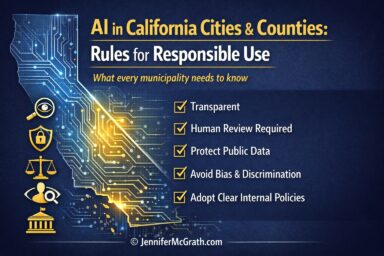
Public Records & Transparency: Under the California Public Records Act (CPRA), AI generated content used for official business is considered a municipal record. AI Policies typically mandate that employees preserve prompts and outputs and that cities and counties explicitly disclose when the public is interacting with an AI tool (such as a chatbot) rather than a human.
Data Privacy & Security: A standard rule across many AI policies prohibits inputting Personally Identifiable Information or sensitive data into public AI tools. If the information wouldn’t be disclosed in a public records request, it cannot be shared with an AI.
Human Oversight and Accountability: A “human-in-the-loop” approach is critical. AI policies often mandate that municipal employees review and verify AI generated content for accuracy before it is shared or used in decision making. Employees must also have the ability to override AI systems when necessary.
Bias Mitigation and Equity: To prevent discriminatory outcomes, particularly in sensitive areas like policing or hiring, AI policies require regular audits of AI outputs to ensure they do not unfairly target specific demographic groups.
Why Municipalities Need Formal AI Guidelines
Without a formal policy, cities and counties face several significant risks.
Shadow AI: This refers to the unauthorized use of AI tools by municipal employees without official oversight, which can lead to inadvertent data breaches or the spread of misinformation.
Public Records Compliance: AI prompts and chat histories are considered public records and must be retained according to official schedules.
Accuracy and Reliability: AI can produce “hallucinations” or outdated information. For example, using AI to answer complex zoning questions without verification can lead to costly misinformation for developers.
State Level Requirements
Local AI policies must now also align with a suite of new California state laws.
Employment Protections: Effective October 1, 2025, updates to the California Fair Employment and Housing Act make it unlawful for municipalities (as employers) to use automated decision systems that result in discrimination.
Data Protection: (AB 1008): AB 1008 extends privacy protections to data used by AI, requiring local governments to manage how personal data is used to train or interact with AI models. The law amends the California Consumer Privacy Act (CCPA) to strengthen data protection in the age of artificial intelligence and clarifies that personal information includes data processed by AI systems and expands consumer rights regarding how their data is used, trained, and stored in these systems.
Law Enforcement Agency Use of Artificial Intelligence (SB 524): SB 524 requires law enforcement agencies to include a disclosure statement and signature on any official report that is generated using artificial intelligence either fully or partially. The first draft must be retained and and the agency must maintain an audit trail.
Political Advertisements (AB 2355): AB 2355 mandates disclosures for AI generated political advertisements for local candidates.
Training Data Transparency (AB 2013): AB 2013 requires developers of generative AI used in California to disclose the datasets used for training, ensuring local governments know what data impacts their AI tools.
Why It Matters
For residents and businesses, these AI policies ensure that their local government remains trustworthy. For municipal employees, these policies provide the guidance needed to experiment with AI tools that can save thousands of staff hours while ensuring the AI tools are used ethically, transparently, and in compliance with existing laws.
Contact us by phone or email to learn more about how we can help.