
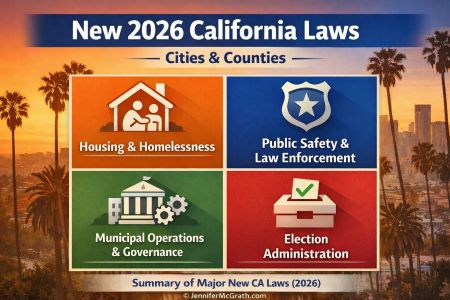
Several new laws taking effect in 2026 significantly impact California cities and counties, particularly in the areas of housing and homelessness, public safety and law enforcement, municipal operations and governance, and election administration. Following are some of the more significant new laws.
Housing and Homelessness
Transit-Oriented Development (SB 79): Overrides local zoning to allow denser, taller residential buildings (up to 75 feet in some cases) within a half-mile of qualifying major transit stops. The law is set to take effect July 1, 2026. Local governments that deny projects meeting SB 79 requirements in high-resource areas face presumed violations of the Housing Accountability Act and liability for penalties beginning January 1, 2027. The California Department of Housing and Community Development gains significant enforcement authority. If HCD finds an ordinance out of compliance and the local government doesn’t take specified steps to address compliance, the department must notify the local government in writing and is authorized to notify the Attorney General.
Housing Reform Law Enforcement (AB 712): Entitles an applicant for a housing development project to reasonable attorney’s fees and costs, and requires a court to impose fines on a local agency, where the applicant is a prevailing party in an action brought by the applicant to enforce the public agency’s compliance with a housing reform law.
Judicial Review of Housing Development Projects (SB 808): Authorizes a petitioner, the Attorney General, or the Department of Housing and Community Development to file a petition for writ of mandate with expedited judicial review for denials of building permits or other entitlements for housing development projects or residential units.
Protection for Outreach Workers (SB 634): Prohibits cities and counties from adopting or enforcing ordinances that prevent individuals or organizations from providing essential support services (medical care, legal aid, food, blankets) to unhoused residents, even in illegal encampments.
Rental Habitability Standards (AB 628): Requires all residential rental units to include a working stove and refrigerator to be considered habitable.
Short-Term Rental Reporting (SB 346): Authorizes cities and counties to require “short-term rental facilitators” (e.g., Airbnb, VRBO) to report detailed information, such as physical addresses and license numbers, every three months. It authorizes the imposition of an administrative fine or penalty for failure to file the report.
Public Safety and Law Enforcement
Masking Ban (SB 627): Prohibits both local California law enforcement and federal law enforcement from wearing facial coverings that hide their identity during operations, except for specific undercover or medical roles.
Visible Identification (SB 805): Requires California and federal non-uniformed law enforcement officers to visibly display identification, including their agency and name or badge number, when performing enforcement duties.
Law Enforcement Agency Use of Artificial Intelligence (SB 524): Requires law enforcement agencies to include a disclosure statement and signature on any official report that is generated using artificial intelligence either fully or partially. The first draft must be retained and and the agency must maintain an audit trail.
Automated Red Light Cameras (SB 720): Allows cities and counties to operate alternative automated camera programs to enforce red-light violations. It provides for the issuance of a notice of violation, an initial review, an administrative hearing, and an appeals process.
Parking Ticket Hardship (AB 1299): Allows a person, at any time, to file a request to participate in a mandatory payment plan for parking citations, and allows cities and counties to waive or reduce parking fines for individuals demonstrating financial hardship or homelessness.
School Zone Speeds (AB 382): Authorizes local authorities to lower school zone speed limits from 25 to 20 mph through ordinance or resolution (through Jan 1, 2031).
Municipal Operations and Governance
Brown Act Updates (SB 707): Implements significant changes to the Brown Act regarding expanded teleconference rules, social media use by officials, easier access to documents, outreach to underrepresented groups, and distribution of a copy of the Brown Act to every newly elected or appointed member of a local legislative body.
Ethics and Financial Training for Local Officials (SB 827): Expands the mandatory ethics training requirement under AB 1234 to include local agency department heads and similar senior administrative officers and creates a new mandatory fiscal and financial training requirement.
Water Infrastructure Streamlining (SB 598): Authorizes a city, county, or special district, upon approval of its governing body, to use the Construction Manager/General Contractor (CM/GC) delivery method for up to 15 projects aimed at alleviating water shortages.
Expedited Permit Reviews (AB 671 & AB 1308): Creates a voluntary path for a licensed architect or engineer to self-certify restaurant building plans (AB 671) and mandates that city and county building departments complete final inspections for certain new residential building construction and residential additions within 10 business days of receiving a notice of the completion of the permitted work (AB 1308).
Online Portals for Housing Development Applications (AB 920): Requires cities and counties with populations of 150,000 or more to create centralized online portals for housing development project applications, which must allow online submittal and status tracking.
Temporary Structures Following Local Emergency Declarations (AB 818): Requires cities and counties to approve or deny complete applications for temporary structures within 10 calendar days following local emergency declarations. This applies to state or federally approved modular homes, prefabricated homes, or detached accessory dwelling units intended for displaced residents.
Counting Housing on Tribal Land Toward Regional Housing Needs Assessment (SB 507): Authorizes cities and counties to enter into a voluntary agreement with a federally recognized tribe to allow new tribal housing development projects to count toward the locality’s share of the regional housing needs allocation.
General Plan Challenges (SB 786): Changes the time requirements for various actions related to a challenge to a city or county general plan and applies its provisions to charter cities.
Public Employee Retirement (AB 1067): Requires a public employer that is investigating a public employee for misconduct to continue the investigation even if the public employee retires while under investigation, if the investigation indicates that the public employee may have committed a crime. Requires the investigation be referred to law enforcement prior to closing the investigation, and requires the employee forfeit any accrued pension rights and benefits if convicted of a felony.
Public Employment Felony Disqualification( SB 521): Expands the list of felonies that preclude a public employee from any public employment for 5 years to include felony conflict of interest (in addition to bribery, embezzlement, extortion, theft, and perjury). Disqualifies a city manager or city attorney, including an individual acting under contract with the city for those services, who is convicted of any of these felonies, from any future public employment in an equivalent role.
Election Administration
Election Canvas and Vote Count Release (AB 5): Requires election officials to finish counting all ballots, with certain exceptions, including provisional ballots and ballots for which the voter must either verify or provide a signature, and release a vote count for those ballots by the 13th day after an election, though counties can file for extensions. Previously, election laws provided counties had until 31 days after elections to submit results to the Secretary of State.
Vote by Mail Ballot Processing (AB 16): Authorizes elections officials to begin processing vote by mail ballots at any point after they are mailed, whereas previously they couldn’t begin processing until 29 days before an election.
Signature Verification (AB 827): Changes the notification deadlines for election officials who receive a vote by mail ballot with a signature that does not match the voter’s registration record. For a regularly scheduled statewide election, election officials must provide notice to the voter of the voter’s opportunity to verify their signature no later than 14 calendar days after the election. The voter may verify their signature no later than 5 p.m. 22 calendar days after the election. For an election that is not a regularly scheduled statewide election, the deadlines is 8 calendar days before certification of the election for the elections official to provide notice, and no later than 5 p.m. 2 calendar days before certification of the election for the voter to verify their signature.
Implementation Challenges and Timeline
The volume of new requirements presents implementation challenges for local governments. With almost 800 California bills becoming law in 2025, cities and counties must allocate staff time and resources to understand, implement, and enforce these mandates. Most laws take effect January 1, 2026, but some became effective earlier as an urgency statute, or have later staggered implementation dates.
Contact us by phone or email to learn more about the new laws affecting California cities and counties.