
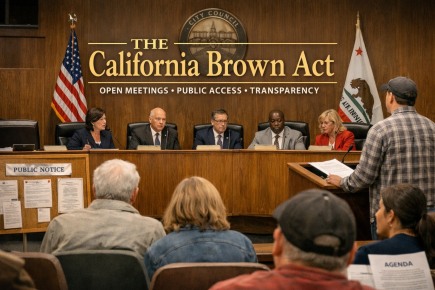
The Ralph M. Brown Act is California’s foundational “sunshine law” and a cornerstone of open and transparent local government guaranteeing the public’s right to attend, participate in, and record meetings of local legislative bodies, ensuring that the “people’s business” is conducted openly and not behind closed doors. Senate Bill 707, enacted in 2025, introduces the most significant modernization of the California Brown Act in decades. The law restructures teleconferencing rules, expands accessibility requirements, and applies new mandates to local agencies starting in 2026.
SB 707 updates the Brown Act to require, among other things, that open meetings include a two-way telephonic or audiovisual option for public attendance and that the public is encouraged to participate through dedicated webpages, easier access to documents, outreach to underrepresented groups, and distribution of a copy of the Brown Act to every newly elected or appointed member of a local legislative body.
Among other new Brown Act rules starting in 2026:
Teleconferencing: Beginning July 1, 2026, and until January 1, 2030, an eligible legislative body is required to comply with additional meeting requirements including that all open and public meetings include an opportunity for members of the public to attend via a 2-way telephonic service or a 2-way audiovisual platform and that the legislative body take specified actions to encourage residents to participate in public meetings.
Social Media Rules: The existing “sunset” on social media rules is removed, permanently allowing officials to communicate with the public online as long as a majority of the body does not deliberate on the same platform.
Language Translation of Agendas: Beginning July 1, 2026, and until July 1, 2030, the agenda for each meeting of an eligible legislative body is required to be translated into all applicable languages (generally defined to mean languages spoken jointly by 20% or more of the applicable population provided that 20% or more of the population that speaks that language in that city or county speaks English less than “very well).
Mandatory Act Distribution: Local agencies must provide a copy of the Brown Act to every newly elected or appointed member of a local legislative body.
Disability Accommodations: Members with qualifying disabilities may participate remotely as a reasonable accommodation. Their attendance counts toward a quorum, and they are not required to post their private address on the agenda.
Expanded “Just Cause” Reasons: Remote participation by members for “just cause” is broadened to include, among other things, a physical or family medical emergency that prevents a member from attending in person.
Meeting Decorum: Authority to remove or mute disruptive participants is expressly extended to teleconferenced and hybrid meetings.
Contact us by phone or email to learn more about the Ralph M. Brown Act as well as California government ethics in general including AB 1234 mandatory ethics training for local agency officials, the California Public Records Act and more.